A Unique Guide to The Brooklyn Botanic Garden
Spectacular in Any Season
The celebrated Brooklyn Botanic Garden (BBG) is a 52-acre living museum. Unlike public parks, it is a curated collection with strict entry rules and specific bloom windows. It's home to the first Japanese-inspired garden built in an American public park and one of the largest bonsai collections in the nation. This guide covers everything you need to make the most of your visit.
Getting There
- Main Entrances: 150 Eastern Parkway (best for subways), 455 Flatbush Avenue, or 990 Washington Avenue.
- Subway (2 or 3): Take the 2 or 3 train to the Eastern Parkway–Brooklyn Museum station. This is the most direct route and puts you right at the garden's iconic main gate.
- Subway (B, Q, or S): Take the B, Q, or S (Franklin Avenue Shuttle) to the Prospect Park station. This is the best stop if you want to use the 455 Flatbush Avenue entrance.
- Subway (4, 5, or S): Take the 4, 5, or S (Franklin Avenue Shuttle) to the Botanic Garden station. From here, it is a short walk to the 990 Washington Avenue entrance.
- The Franklin Avenue Shuttle (S): This short, localized connector line runs between Franklin Avenue (A/C lines) and Prospect Park (B/Q lines). It is a "secret weapon" because it allows visitors coming from Bed-Stuy or northern Crown Heights to cut straight across to the Garden in minutes, bypassing the need to transfer at the crowded Atlantic Terminal hub.
- The "Botanic Garden" Station Nuance: While the Botanic Garden station (serving the 4, 5, and S trains) sounds like the most obvious choice, it actually requires a 5-minute walk to reach a gate. For the most "door-to-door" experience Eastern Parkway–Brooklyn Museum station (serving the 2 and 3 trains) is the only one that drops you directly at the garden entrance.
- Accessibility: The Eastern Parkway–Brooklyn Museum station is fully ADA accessible with elevators, making it the preferred choice for those with strollers or mobility needs.
Know Before You Go:
- Are Kids Allowed? Yes, children are welcome, but the BBG is a "living museum" rather than a playground. To protect the plants, kids are not allowed to run, climb trees, or play on the lawns (except for the Cherry Esplanade). For active play and digging, head straight to the Discovery Garden, which is the only area designed for hands-on exploration.
- What are the Costs? Adult tickets are approximately $22, while Students (12+ with ID) and Seniors (65+) are $18. Children under 12 are always free. Pro Tip: You can reserve free "Community Tickets" on the official website in advance, but they are limited and claimable on a first-come, first-served basis.
- Is there a place to eat? You can visit the popular Yellow Magnolia Café for a sit-down meal or the Yellow Magnolia Canteen for quick snacks. Pro Tip: The Café fills up fast on weekends and during bloom seasons, so be sure to make a reservation online.
- Can I bring my own food? Outside food is strictly prohibited inside the garden. If you pack a lunch, you must eat it at the designated picnic area located just outside the 990 Washington Avenue entrance.
- Can I buy a pass? Yes, the BBG offers Annual Memberships that usually pay for themselves after just two visits. Members get special perks like "Member-Only" morning hours, which are perfect for photographers who want the garden to themselves.
- How much time should I allot? Plan for 2 to 3 hours to see the main highlights at a steady pace. If you intend to photograph the collections in detail or stop for a full meal at the Yellow Magnolia Café, give yourself 4 hours to ensure you aren't rushing through the conservatory or back gardens.
- Days & Hours: The garden is typically closed on Mondays. Hours change seasonally, with longer "sunset hours" in the summer and shorter days in the winter. Always check the official BBG website for today's specific hours before you leave.
- The "No-Go" List: No picnics, no blankets, no tripods, and no pets. To protect the rare and delicate plant collections, all visitors are required to stay on the designated paved or gravel paths at all times.
Pro Tips:
- Free Tours: Look for the "Seasonal Highlights Tour" which runs Tuesday–Sunday at 1:00 PM. It's free with admission and is the best way to find hidden blooms you might otherwise walk right past. They offer other tours too, check the website for details.
- The "Golden Hour" Strategy: For the best photos and the fewest crowds, arrive right at 8:00 AM. If you are a member, take advantage of the Summer Evenings on Wednesdays for sunset views and rare picnic access on the lawn.
- Souvenirs with Style: The gift shop (Terrain at BBG) is widely considered one of the best museum shops in NYC. It’s located at the Washington Ave entrance and specializes in rare plants and locally-made Brooklyn crafts.
- Community Greening: If you visit in early May, look out for the "Making Brooklyn Bloom" events, where you can often pick up free seeds or vegetable starts to take home!
What to See
Plan for 3+ hours if you want to see it all. If you only have 2 hours, then head straight to the Japanese Hill-and-Pond Garden, walk across the Cherry Esplanade, and finish at the C.V. Starr Bonsai Museum. If it's June, you should swap the Bonsai Museum for the Rose Garden. It's right next to the Esplanade and is world-famous during that specific month.
The Heritage Gardens
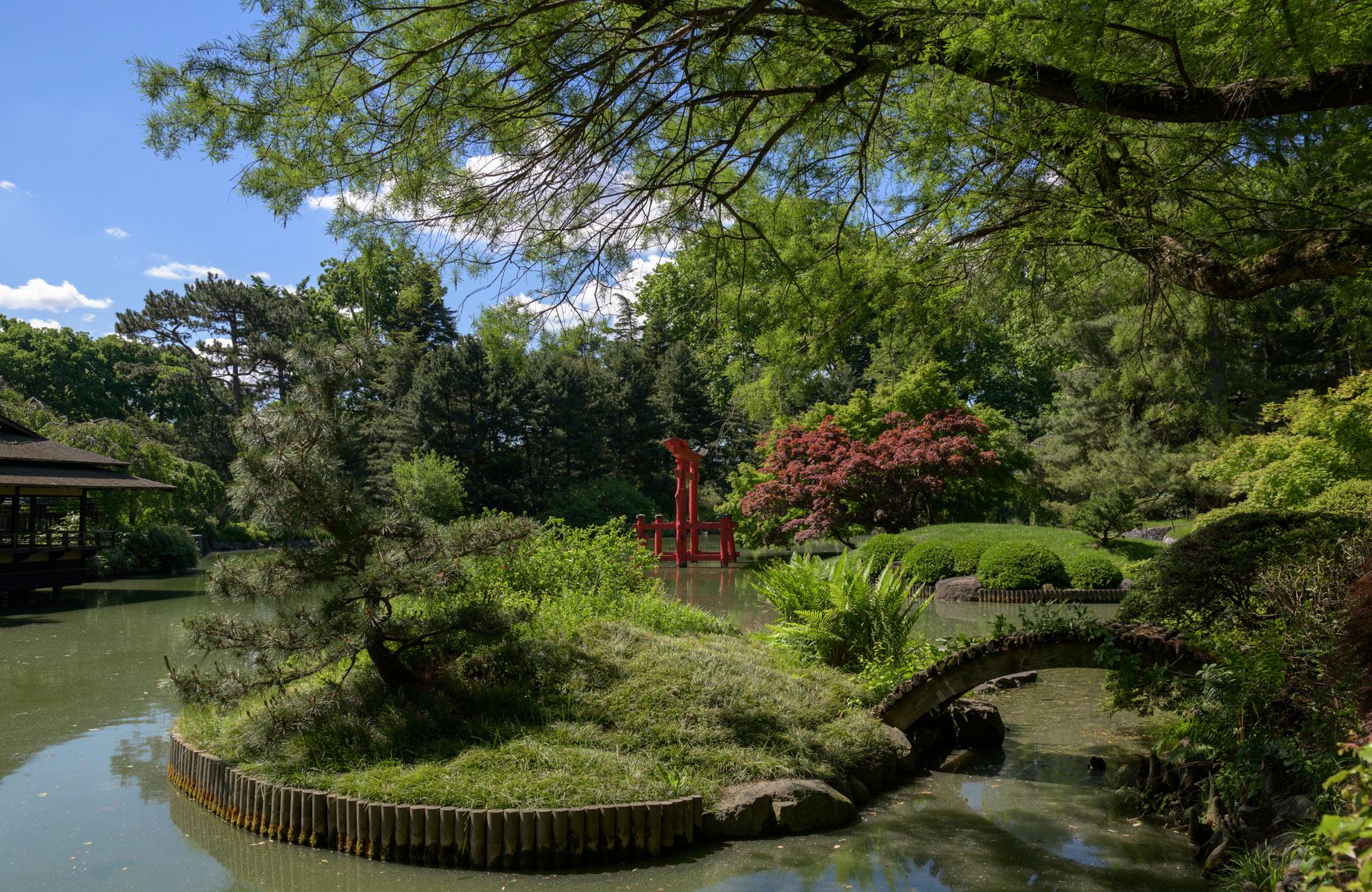
Japanese Hill-and-Pond Garden
- Size: 3 acres.
- Best Time: Fall or Early Spring. (Japanese maples in Oct/Nov; Cherries in April).
- Why: In late October, the maples turn a brilliant fiery red that reflects off the pond. In April, the weeping cherries along the water create a classic "Sakura" scene.
- What is it: One of the oldest Japanese-style gardens in an American public park (dedicated in 1915). It features a Shinto shrine, a pond filled with oversized koi, and a "stroll" layout designed by landscape architect Takeo Shiota.
- Great for: Photographers and peace-seekers.
- Fun Facts: The original Shinto shrine was burned down in 1939 and wasn't replaced until 1960. The red Torii gate in the water is modeled after the world-famous gate at Itsukushima Shrine in Miyajima, Japan.
Cranford Rose Garden
- Size: 1 acre.
- Best Time: June. (The only month to see the full collection in one massive bloom).
- Why: This is the only window where nearly all 1,000+ species bloom simultaneously, creating an overwhelming sensory experience.
- What is it: A massive display of over 1,000 types of roses, from "Old Garden" species to modern hybrids. It covers roughly an acre and is one of the most famous rose collections in the world.
- Great for: Romantic strolls and fragrance lovers.
- Fun Facts: The garden was funded by Walter Cranford, the engineer whose company built many of Brooklyn's subway tunnels. Some of the original rose bushes planted when the garden opened in 1927 are still alive and blooming today.
Shakespeare Garden
- Size: 0.5 acres.
- Best Time: Late Spring. (May and June when the English perennials are tallest).
- Why: This English cottage-style garden relies on traditional perennials like bluebells and lilies that are at their peak height and fullness during these months.
- What is it: An English cottage-style garden featuring more than 80 plants mentioned in William Shakespeare’s plays.
- Great for: Literature buffs and "dark academia" aesthetics.
- Fun Facts: Each plant is paired with a specific quote. For example, you'll find "Pansies, that's for thoughts" (Hamlet) right next to the actual flowers.
Native Flora Garden
- Size: 3.5 acres.
- Best Time: April or October. (Rare wildflowers in spring; deep forest foliage in fall).
- Why: April is the window for "spring ephemerals"—tiny woodland wildflowers that bloom briefly before the trees grow leaves. October offers a dense, forest-like autumn foliage experience.
- What is it: A reconstruction of the local New York landscape as it existed before urbanization, featuring a limestone ledge and a pine barrens bog.
- Great for: Birdwatchers and nature purists.
- Fun Facts: This was the BBG’s very first exhibit, opened in 1911. It acts as a "lifeboat" for endangered local plants that can no longer survive anywhere else in NYC.
Signature Landscape Features
Cherry Esplanade & Cherry Walk
- Size: 4 acres.
- Best Time: Mid-to-Late April. (Strictly during the 10-day peak bloom).
- Why: This is the strictly limited window when the 'Kanzan' cherry trees create their famous pink "tunnel." Outside this window, it is a simple green lawn.
- What is it: A vast lawn lined with double-flowering 'Kanzan' cherry trees that create a thick pink canopy.
- Great for: Social media photos and picnic-style lounging.
- Fun Facts: The garden uses a "CherryWatch" tracker on its website so you don't waste a trip. The "Liberty Oaks" bordering the lawn were planted in memory of those lost on 9/11.
Osborne Garden
- Size: 3 acres.
- Best Time: May. (When the purple wisteria clusters hang from the pergolas).
- Why: The massive timber pergolas are draped in wisteria, which blooms in heavy purple clusters specifically during this month, paired with bright azaleas.
- What is it: An Italianate formal garden with stone fountains, emerald lawns, and 14-foot stone columns.
- Great for: Families and architecture fans.
- Fun Facts: It features "Whispering Benches" at the north end. If you whisper into one side of the curved stone bench, a person sitting at the opposite end can hear you perfectly due to the acoustic design.
Lily Pool Terrace
- Size: 0.75 acres.
- Best Time: July – September. (Water lilies require peak summer heat to open).
- Why: Unlike most flowers, water lilies and lotuses require intense summer heat to surface. They are dormant or invisible during the spring and fall.
- What is it: Two large rectangular pools housing nearly 100 species of water lilies and sacred lotuses.
- Great for: Mid-summer visitors looking for color.
- Fun Facts: The garden grows both "hardy" lilies (which stay in the water year-round) and "tropical" lilies. The tropical varieties are the ones that produce the giant, exotic-looking upright flowers.
Celebrity Path
- Size: ~500-foot linear path.
- Best Time: All Seasons. (Hardscape stones are always visible).
- Why: This is a hardscape feature made of engraved stones; it is unaffected by weather and always accessible for reading.
- What is it: A stone walkway engraved with the names of famous Brooklyn residents from Walt Whitman to Jay-Z.
- Great for: History fans and pop-culture hunters.
- Fun Facts: Each celebrity’s name is embedded in a colored paver decorated with a bronze leaf outline. Each leaf represents a specific tree species found elsewhere in the garden.
Specialty Collections & Indoor
Rock Garden
- Size: 1 acre.
- Best Time: March & April. (Alpine flowers bloom as soon as the frost breaks).
- Why: Most alpine plants are "early risers" that bloom as soon as the snow melts. In later months, many of these plants go dormant to survive the heat.
- What is it: A rugged landscape built from boulders featuring plants that thrive in rocky, mountain-like soil.
- Great for: Early-season visitors.
- Fun Facts: The massive boulders were unearthed on-site during construction and were originally left behind by melting glaciers at the end of the last Ice Age.
Discovery Garden
- Size: 1 acre.
- Best Time: All Seasons. (Hands-on education year-round).
- Why: It is designed for year-round education. The boardwalks through the marsh and meadow provide different sensory experiences (ice in winter, tadpoles in summer).
- What is it: A tactile space where children can explore a marsh boardwalk, a meadow, and an "insect hotel."
- Great for: Families with young children.
- Fun Facts: The garden features an "Insect Hotel" that specifically hosts leaf-cutter bees, praying mantises, and termites to show kids how urban ecosystems work.
C.V. Starr Bonsai Museum (Indoor)
- Size: Indoor Pavilion.
- Best Time: All Seasons. (Exhibits are rotated frequently).
- Why: The curators rotate the trees frequently so that visitors always see specimens that are currently "in their prime," whether they are fruiting, flowering, or showing fall color.
- What is it: One of the most significant bonsai collections in the Western Hemisphere, featuring miniature masterpieces trained over decades.
- Great for: Art lovers and fans of Japanese culture.
- Fun Facts: The museum houses a Rocky Mountain Juniper that is over 500 years old and a Sargent Juniper that is estimated to be over 800 years old, making them some of the oldest living things in the Northeast.
Your Urban Retreat
Adjacent to the Brooklyn Botanic Garden, brand-new apartments at Loden in Crown Heights pair modern with a soul-nurturing, nature-inspired aesthetic. Explore our beautiful residences and unique luxury amenities.